How to use AI to improve quantitative market research
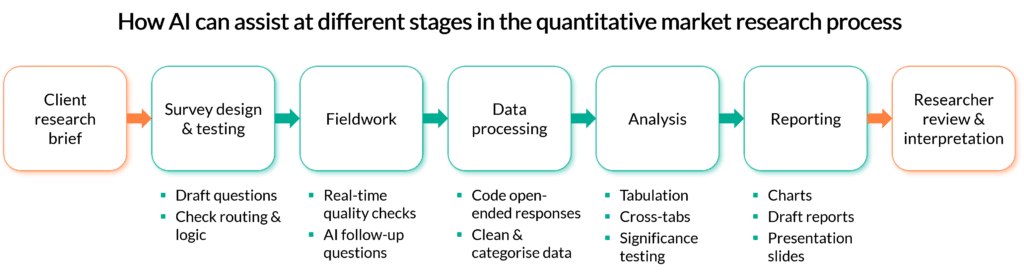
In quantitative market research, AI can help researchers design and set up surveys faster, and later assist with reporting by analysing open-ended responses, tabulating data and creating charts and draft reports. Emerging applications include real-time quality checks while surveys are in field and the use of synthetic respondents to simulate how different groups of people might respond to a survey.
Quantitative research has always been the more process-driven side of market research: structured questionnaires, large samples and statistical rigour designed to produce numbers that clients can trust. This makes it particularly well suited to AI, which excels at the repetitive, pattern-based work that quantitative studies generate at scale.
This article discusses how AI can assist at different points in the quantitative research workflow, from designing a survey to compiling the final report (see also our earlier article on how AI can assist with qualitative research).
Survey design and logic checking
Writing a long, multi-section survey questionnaire is a painstaking task, and it is easy for small errors to creep in: a routing instruction that skips the wrong respondents, a scale that is inconsistent with an earlier question, or wording that unintentionally leads towards a particular answer. AI tools can generate a first draft from a brief, proposing question wording, response scales and a logical flow from screening through to core measurement sections.
Just as valuable is AI’s ability to check a finished survey for internal consistency. It can flag routing logic that does not match the stated skip patterns, ambiguous wording and inconsistencies between sections. While automated review does not remove the need for thorough testing by our team and the client, we’ve found that it can be very helpful in catching errors before human testing begins.
Real-time, in-survey quality checks
Data quality has always been one of the biggest challenges in online quantitative research. To some extent AI is making the problem worse by, for example, enabling respondents to generate convincing answers to open-ended questions without prior knowledge. However, AI can also be part of the solution by detecting suspicious behaviour as it occurs.
The incorporation of AI quality control tools in online survey platforms is still at a fairly early stage, but it seems likely that fairly soon AI will be able to flag in real time:
questions being answered implausibly fast
straight-lining or other patterned behaviour across grid questions
contradictory answers within and across questions
open-ended responses that are generic, nonsensical or potentially written by AI
responses suspiciously similar to those already collected.
Catching poor-quality respondents during fieldwork is far cheaper and more reliable than trying to clean the data retrospectively, when researchers may have to make judgement calls about borderline cases.
If you feed survey responses into an AI tool, always make sure that it complies with client confidentiality, GDPR/data-protection requirements and applicable research-industry standards.
Chatbot-based qualitative follow-up questions
One of the most exciting developments in quantitative research is the ability to combine structured survey questions with AI-powered conversational follow-up.
Instead of asking every respondent identical open-ended questions, AI can generate personalised follow-ups based on previous answers. For example, if a respondent is dissatisfied with a product, AI can ask what specifically caused that dissatisfaction. If another expresses high purchase intent, it can explore the reasons behind their enthusiasm.
This creates richer datasets that combine the statistical robustness of quantitative research with some of the depth traditionally associated with qualitative interviews. These interactions remain relatively short and focused but can provide valuable context that would otherwise be unavailable from closed questions alone.
Analysis and categorisation of open-ended responses
Open-ended questions often contain some of the richest insights within a quantitative study, but analysing thousands of responses has traditionally required considerable manual effort.
There are now commercially available AI tools that automatically categorise responses by identifying recurring themes, grouping similar comments and assigning preliminary codes. These tools usually allow researchers to upload an existing codebook or specify a target number of codes for the AI to generate.
AI coding is not a fully hands-off process. Researchers should review and refine AI-generated code frames before applying them at scale and spot-check coded responses against the source text to ensure the categorisation reflects what respondents meant.
Once those checks are completed, AI can accomplish in minutes what previously required days of manual coding. It can also work across multiple languages and identify different ways of expressing the same concept.
Tabulation of results from raw data
Most commercial online survey platforms can produce tables for individual questions and straightforward cross-tabulations, such as results by age group or gender. More complicated cross-tabulation has traditionally required dedicated tabulation software or a statistician working through the data manually.
AI tools can now generate tables directly from raw datasets and instructions, applying weights, calculating statistical significance between subgroups and producing cross-tabulated outputs in a specified layout. These can include segments based on responses to combinations of closed and open questions.
This saves considerable time and allows researchers to interrogate the data from several angles before settling on the cuts that matter most for the final report.
Automation of reporting: first-draft decks and conclusions
The final stage of a quantitative project is turning the data into a report or presentation, another area where AI can save considerable time. Given a tabulated dataset and the study objectives, AI tools can produce charts and incorporate them into a report with headline statistics and summaries of the key findings.
We find that an AI-generated report is best treated as a first draft rather than a finished deliverable. AI is good at describing what the data shows and highlighting statistically notable differences, but less good at understanding why those differences matter to the client’s business or weaving the findings into a strategic narrative.
The most effective approach is to let AI handle the mechanical work of building charts and drafting descriptive text, leaving the researcher to focus on interpretation, prioritisation and conclusions.
Synthetic respondents
Another emerging application of AI is the use of synthetic respondents: AI-generated participants designed to simulate how particular groups of people, usually consumers, might answer survey questions (see our earlier article on synthetic respondents).
Using existing survey data, panel profiles or broader demographic and behavioural datasets, AI models can generate plausible response patterns for a target population without fielding a live study.
Synthetic respondents can be useful for testing questionnaires, exploring hypotheses, modelling scenarios and generating preliminary results before investing in fieldwork. They may also help explore hypotheses about difficult-to-reach audiences, although limited underlying data can make synthetic results for these groups particularly uncertain.
Synthetic respondents should therefore be treated with considerable caution. Their answers are generated from existing data and assumptions embedded within AI models rather than the experiences and opinions of real people. This risks reinforcing existing biases, missing emerging behaviours or producing apparently convincing results that do not genuinely represent the target population.
For now, synthetic respondents are best viewed as a complementary tool rather than a replacement for real respondents. They can help test ideas and develop hypotheses, but important business decisions should continue to be grounded in robust research with genuine participants.
Combining AI with human expertise
With the exception of synthetic respondents, AI’s impact on quantitative research is similar to its impact on qualitative research, which we explored in an earlier article: it excels at speeding up routine tasks and processing large volumes of data.
Freeing researchers from these tasks allows them to spend more time understanding what the data is really saying in the context of the client’s business and helping clients to make better-informed decisions.
As with qualitative research, the organisations that benefit most from AI will be those that use it to support experienced researchers rather than replace them. Combining technological efficiency with human expertise delivers faster projects, higher-quality outputs and, ultimately, more valuable research.
Frequently Asked Questions
1
How is AI being used in quantitative market research?
AI is being used across the quantitative research process, from survey design and logic checking to real-time quality control, analysis of open-ended responses, tabulation and automated reporting. It can reduce the time spent on repetitive tasks while helping researchers focus more on interpretation, methodology and business implications.
2
Can AI improve the quality of online survey data?
Yes. AI can help identify poor-quality responses while a survey is still in field by detecting patterns such as implausibly fast answers, straight-lining, contradictions and suspicious open-ended responses. Real-time checks can help researchers address quality issues before they become part of the final dataset.
3
Can AI analyse survey data and create research reports?
AI can categorise open-ended responses, generate tables and cross-tabulations, highlight notable differences between groups and produce first drafts of reports or slide decks, including charts and written summaries. However, researchers should still validate the outputs and provide the interpretation and recommendations that give the findings their business value.
4
What are synthetic respondents in market research?
Synthetic respondents are AI-generated participants designed to simulate how particular groups of people might answer survey questions. They can be useful for testing questionnaires, exploring hypotheses and modelling scenarios, but they should not currently be treated as a replacement for research with real respondents, particularly where important business decisions are involved.