
Research in the last 3 months of 2025: the fieldwork point of view
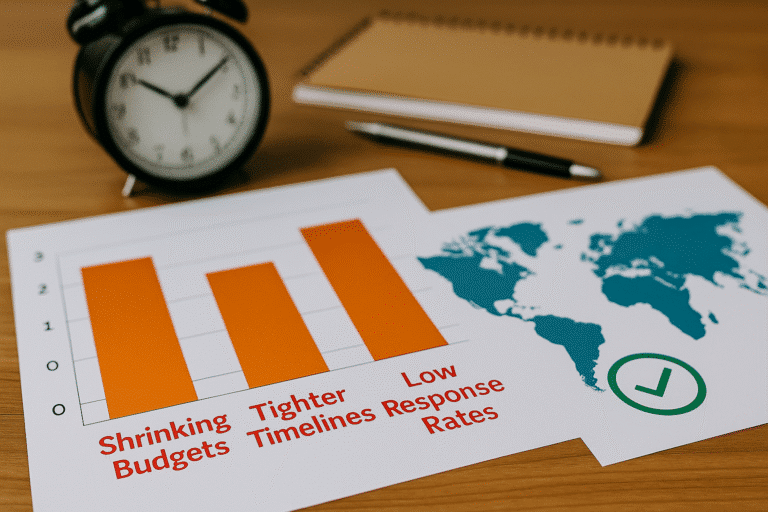
The three months from October to December are always an intense period in market research agencies. Timelines get compressed, project costs need to align with the amounts remaining in clients’ budgets, and everyone wants answers before the year closes. But in Q4 2025, we feel the pressure points have changed. What clients expect from fieldwork partners, and what it actually takes to deliver effectively, have shifted in important ways.
Across hundreds of briefs, feasibility checks and live projects, these are the five realities defining fieldwork at the end of 2025.
1. Smaller budgets, bigger expectations
We see this as the defining tension in fieldwork projects at present. Clients want more insight, across more markets and in more depth, but with less money. Budgets that were previously adequate for multi-market qualitative projects are being squeezed to the limits of attainability.
What this means in practice:
- Recruitment must become more targeted and inventive
- Incentives must remain fair or the quality of respondents deteriorates fast
- Methodologies often need redesigning to stay feasible with budget constraints
- Boundaries must be established clearly from day one.
FieldworkHub’s role is increasingly strategic. We help clients right-size objectives and allocate budget where it will have the greatest impact, rather than attempting to force unrealistic project designs through the system.
2. Hard-to-reach audiences are becoming the norm, not the exception
This quarter has brought a noticeable rise in briefs targeting audiences that are hyper-niche, very senior in their roles, or over-researched and tired of participating. This includes:
- Specialised consumer groups such as luxury travellers or early tech adopters
- Senior HCPs in pressured healthcare systems
- B2B audiences with large budgets and ultimate decision-making authority
- Financial and technical roles with limited time and high levels of scrutiny.
Operationally, this means:
- ID verification and layered screening are essential
- AI has made misrepresentation harder to detect, so validation must go deeper
- Video and LinkedIn verification is increasingly required for certain audiences
- Pro-active management of participants is need to achieve higher show rates as there is less budget for over-recruitment.
This is the area where strong fieldwork partners stand out sharply from weak ones. Quality recruitment is no longer about filling quotas. It is about proving credibility.
3. Timelines have tightened but the work has become more complex
This is another contradiction of market research in 2025. Projects are more complicated yet they are expected to move faster.
Examples that we see daily include:
- Multi-country schedule compressed from three weeks into ten days
- Recruitment windows halved while the criteria stay the same
- Moderation, translation, incentives and data handling running in parallel, not in sequence.
This is exactly where fieldwork quality rises or collapses. Logistics is no longer an operational function; it is a strategic one.
The first 48 hours after a project is commissioned increasingly determine the entire trajectory of the project FieldworkHub’s experience shows that proactive communication and clear expectation-setting are the deciding factors between controlled delivery and a crisis.
4. Quality concerns are higher than ever and clients want proof, not promises
Clients are no longer satisfied with general statements about quality. They want to see:
- How respondents are validated across markets
- How fraudulent applications are detected
- How digital and AI-driven risks are mitigated
- What contingency plans exist if something goes wrong.
With budgets under pressure and insight teams accountable for outcomes, tolerance for errors is close to zero. Misaligned profiles, rushed screening, poor hygiene and “professional respondents” are no longer viewed as operational issues. They are seen as business risks.
Reliability is becoming a differentiator. Clients want partners who can demonstrate rigour, not just offer vague assurances that all will be well.
5. Fieldwork partners are being chosen for their judgment, not just their execution
In Q4 2025, clients want more than someone who can “run fieldwork”, they want a partner who can:
- Push back on unrealistic criteria
- Propose alternative routes when feasibility is challenging
- Anticipate risks before they materialise
- Simplify complex or ambitious recruitment plans
- Provide expert guidance on whether a study design will work.
This is a meaningful shift. Value is no longer measured by completion alone. Value is measured by protecting the integrity of the insight.
At FieldworkHub, this means acting simultaneously as advisor, risk assessor, quality gatekeeper and delivery partner.
Final thoughts: The Q4 2025 reality
We can sum up the current state of fieldwork projects with one line:
Smaller budgets. Harder respondents. Shorter timelines. Higher expectations.
And yet, the research still has to achieve client goals, the insight still has to make sense and the findings still need to provide a robust foundation for decision making.
In this environment, the fieldwork partner you choose becomes one of the most critical decisions in the project, not a procurement formality.
At FieldworkHub, we continue to do our utmost to make good research possible, even when constraints are tight and conditions are challenging.
If you are planning research for early 2026 and want fieldwork that is realistic, high-quality and grounded in experience, we would be happy to support you. Contact us today for more information.